4 Leading AI Security Tools for Preventing Deepfake Fraud in 2026

Our guides are based on hands-on testing and verified sources. Each article is reviewed for accuracy and updated regularly to ensure current, reliable information.Read our editorial policy.
Deepfake fraud is a real problem in 2026. Generative AI now lets fraudsters build synthetic identities, manipulate videos, and run realistic impersonations, all fast enough to bypass the onboarding systems most enterprises still rely on.
Fintech, telecom, digital banking, online gaming, and marketplace platforms are the most exposed. Identity verification is central to how these businesses operate, and that makes them a target. According to Bright Defense, deepfake fraud attempts have surged 2,137% over the last three years, with a new attack attempted every five minutes in 2024.
Traditional systems were not built to handle AI-generated attacks at scale. So enterprises are shifting to biometric liveness detection and real-time identity verification tools to close the gap.
Why Deepfakes Break Traditional Fraud Detection
Traditional fraud detection trusts a narrow set of signals: a submitted ID, a password match, a device fingerprint, a rule triggered by suspicious behavior. Deepfake attacks are built specifically to pass those checks.
The attacker shows up with the right face, the right document, and the right login pattern at exactly the moment verification happens.
The bigger issue is how most legacy systems evaluate risk, in isolated steps. A document check passes without confirming liveness. A credential match succeeds without proving who is actually behind the session. Each step works. The combined result still fails.
This is not a theoretical risk. Gartner predicted that by 2026, 30% of enterprises would no longer consider standalone identity verification solutions reliable in isolation, specifically because of AI-generated deepfake attacks on face biometrics. Gartner also noted that injection attacks, where fraudsters bypass the camera entirely by injecting synthetic video into the data stream, increased 200% in 2023 alone.
Modern platforms now combine passive liveness detection, biometric verification, behavioral analysis, and AI-driven fraud detection into a single flow. The goal is to assess identity, device signals, and session risk all at once, before access is granted.
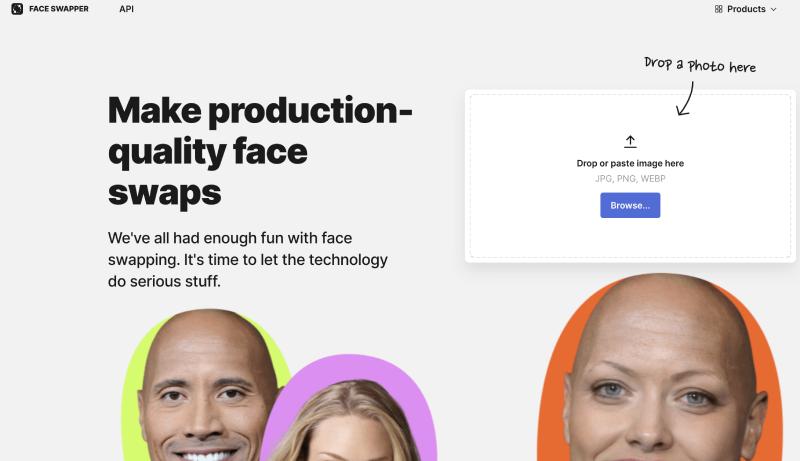
You can also see this dynamic playing out in marketing tech. AI tools that generate realistic avatar videos are built on the same underlying synthetic media technology that teams are now racing to detect. The gap between creative tools and fraud tools is thin.
Quick Comparison
Before diving into each tool, here is how they stack up across the features that matter most.
| Tool | Core Strength | Deepfake-Specific Focus | Best For |
|---|---|---|---|
| Incode | Proprietary AI stack + liveness detection | High, built around deepfake resistance | Regulated, high-fraud industries |
| Jumio | Document-first KYC at global scale | Moderate | Compliance-heavy onboarding |
| Veriff | High-volume global onboarding | Moderate | Marketplaces and mobility platforms |
| Socure | Data intelligence + risk scoring | Lower, data-centric, not biometric-first | Financial services analytics |
Let’s go through each one.
1. Incode
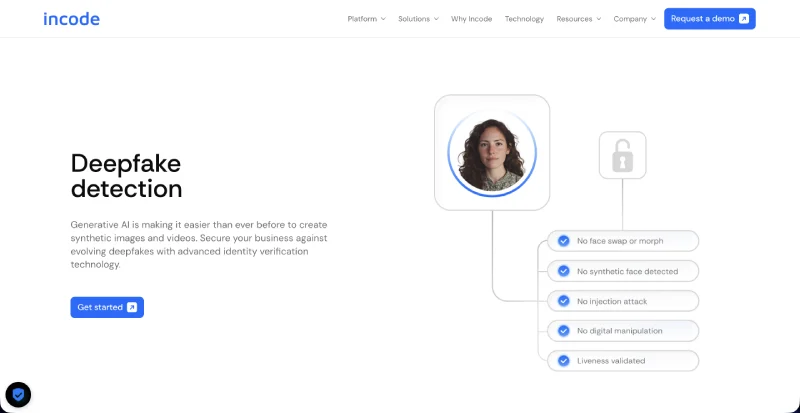
Incode is an enterprise-grade, AI-powered identity verification platform built for organizations that need to prevent deepfake fraud while keeping digital onboarding secure and frictionless.
The platform combines biometric liveness detection, passive liveness detection, document verification, ongoing authentication, and deepfake detection into a unified identity verification workflow. Its DeepSight platform uses AI-driven deepfake detection technology to identify manipulated media, synthetic identities, and injection attacks during onboarding and authentication flows.
One of Incode’s strongest differentiators is its proprietary technology stack. Most identity verification providers assemble third-party components. Incode builds its technology in-house. This allows faster custom model retraining, more adaptable fraud detection, and quicker responses to emerging AI-generated fraud patterns.
Incode is a Gartner Magic Quadrant Leader in identity verification and serves nine of the ten largest banks in the United States. Its enterprise customer list includes AT&T, Citi, Amazon, TikTok, and FanDuel.
The platform is widely used in fintech, telecom, and online gaming, industries where KYC/AML compliance automation and biometric fraud prevention are non-negotiable. Incode also emphasizes reducing false positives and frictionless onboarding, helping enterprises improve customer conversion rates without weakening identity assurance.
Incode is a good fit if you are in a regulated or fraud-heavy environment and need deepfake-resistant identity verification, biometric security, compliance automation, and low-friction onboarding at scale.
2. Jumio
Jumio is a well-known identity verification provider focused on banking, fintech, and other regulated industries. It covers digital onboarding through document verification, biometric authentication, and KYC compliance workflows.
Its strongest asset is experience. Jumio has a long track record in environments where global compliance coverage and scalable KYC tooling are essential.
Compared with newer platforms, Jumio remains closer to a document-first architecture. It has biometric verification and fraud prevention capabilities, but it is not primarily positioned around deepfake resistance. This means it is a solid choice for compliance-driven onboarding, but a weaker fit if deepfake detection is your primary concern.
3. Veriff
Veriff is an AI-powered identity verification platform built for high-volume global onboarding. It supports real-time verification and covers international document types for businesses operating across multiple regions.
It is popular with fintech companies, marketplaces, and mobility apps, platforms that need automated verification workflows without creating unnecessary friction for legitimate users.
Veriff’s core strength is scale and global coverage. Where it is less differentiated is in deepfake-specific defense. If AI-generated synthetic identity attacks are your primary threat model, Veriff works well as part of a layered approach but may not be enough on its own.
4. Socure
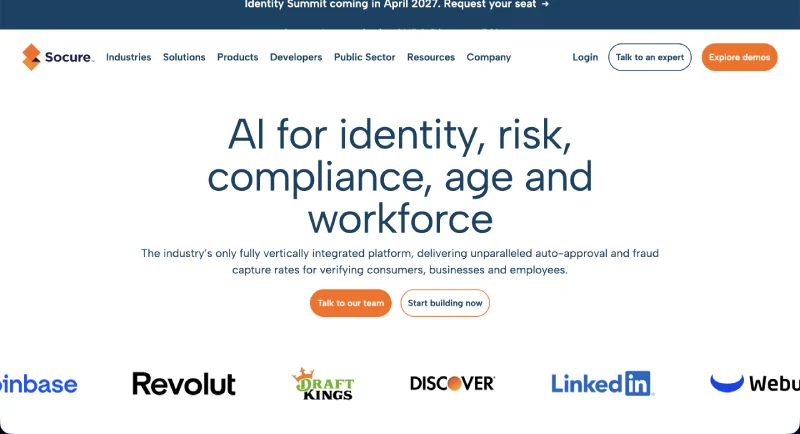
Socure focuses on identity intelligence and AI-driven fraud analytics for enterprises in regulated industries. Its platform uses machine learning, automated risk scoring, and behavioral analysis to evaluate identity risk during onboarding and authentication.
It is particularly active in financial services. The platform analyzes identity signals and behavioral data in real time to flag suspicious activity and reduce fraud risk.
Socure’s approach is data-centric rather than biometric-first. It is strong at scoring identity risk across large datasets and automating compliance-ready decisions. But it places less emphasis on liveness verification and manipulated media detection than platforms built specifically around deepfake threats.
This makes Socure a better fit for fraud analytics and risk scoring than for frontline deepfake defense.
What to Look for in a Deepfake Prevention Platform
If you are evaluating tools in this space, these are the four capabilities that separate effective platforms from ones that are just keeping up.
| Feature | Why It Matters |
|---|---|
| Passive Liveness Detection | Verifies a real person is present without adding friction, reduces spoofing and deepfake impersonation |
| Proprietary AI Models | Allows faster retraining and adaptation to new attack types; third-party model stacks respond more slowly |
| Real-Time Fraud Detection | Stops manipulated media before a fraudulent account is approved, not after |
| Automated Compliance | Reduces manual review burden for regulated businesses and supports faster audit response |
Understanding how these systems work at a technical level is useful if you are part of the team evaluating them. It is also worth knowing that the same generative AI powering AI avatar generators is the same technology fraud teams are defending against. Synthetic faces that look completely real are not a future problem. They are already the baseline for fraud attacks in 2026.
The Bottom Line
Deepfake fraud will keep evolving. Generative AI is not slowing down, and neither are the fraud patterns built on top of it.
According to fintech.global, global identity fraud losses exceeded $50 billion in 2025, with 2026 on track to surpass that. Static fraud detection and document-only verification are no longer enough.
The platforms doing this well combine biometric liveness, deepfake detection, real-time session risk analysis, and automated compliance into a single infrastructure. Incode, Jumio, Veriff, and Socure each take a different angle on that problem.
Which one fits your organization depends on whether your priority is deepfake-specific defense, compliance automation, global scale, or data-driven risk scoring.
About Himanshu Tyagi
At CodeItBro, I help professionals, marketers, and aspiring technologists bridge the gap between curiosity and confidence in coding and automation. With a dedication to clarity and impact, my work focuses on turning beginner hesitation into actionable results. From clear tutorials on Python and AI tools to practical insights for working with modern stacks, I publish genuine learning experiences that empower you to deploy real solutions—without getting lost in jargon. Join me as we build a smarter tech-muscle together.