AI Bot Traffic Trends 2026: Growth, Spoofing, and Security Risks

Our guides are based on hands-on testing and verified sources. Each article is reviewed for accuracy and updated regularly to ensure current, reliable information.Read our editorial policy.
AI bot traffic is growing rapidly. AI assistants, search crawlers, and autonomous agents are generating billions of requests across websites and APIs. Some retrieve public information, while others interact with login pages, forms, and account-related features.
For website owners and developers, this creates a challenge. A legitimate AI crawler retrieving product information can appear alongside automated scripts probing sensitive endpoints. Both generate server requests, but their purposes and security implications are different.
DataDome’s 2026 State of Bot & Agent Security Report provides a closer look at these changes. The company analyzed traffic across more than 75,000 customer websites and detected 52.7 billion requests from AI agents and large language model (LLM) crawlers between July 2025 and June 2026.
Here are the report’s most important findings, what they mean for SEO and website security, and how developers can identify and manage AI-generated traffic.
AI Bot Traffic Increased 82.3% in DataDome’s 2026 Report
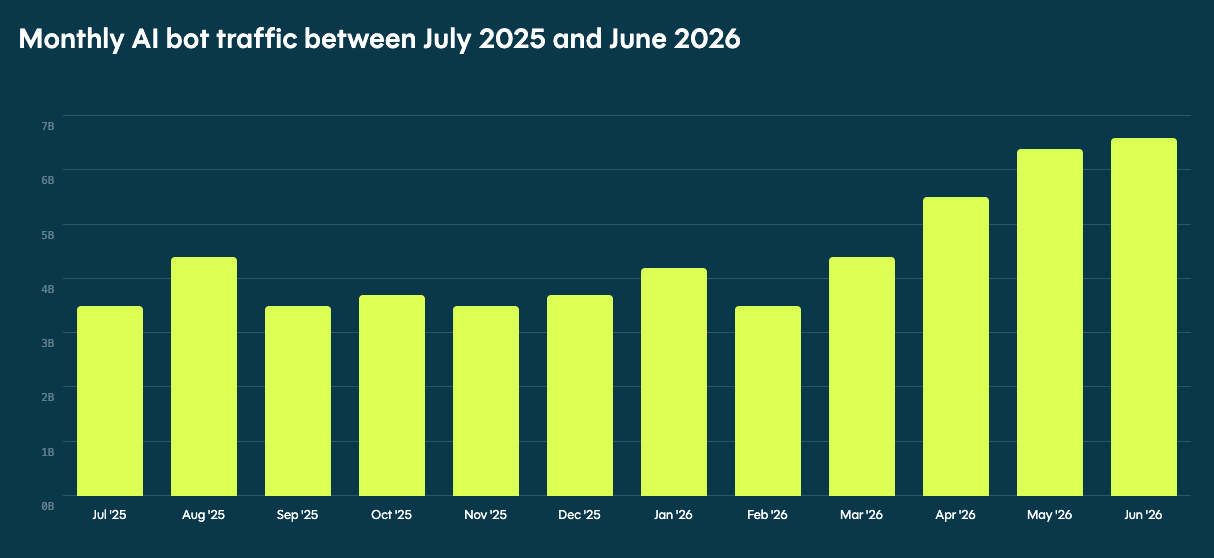
According to DataDome’s 2026 AI traffic report, AI agent and LLM crawler activity increased 82.3% between July 2025 and June 2026.
The company recorded 52.7 billion AI requests during the 12-month reporting period. Monthly volume rose from approximately 3.5 billion requests in July 2025 to 6.6 billion in June 2026.
However, growth was not consistent throughout the year. Activity declined in September 2025 and February 2026 before accelerating again during the following months.
| Metric | DataDome Finding |
|---|---|
| Reporting period | July 2025 to June 2026 |
| Total AI agent and LLM crawler requests | 52.7 billion |
| AI traffic growth | 82.3% |
| Monthly requests in July 2025 | Approximately 3.5 billion |
| Monthly requests in June 2026 | Approximately 6.6 billion |
| AI share of analyzed traffic in July 2025 | 1.2% |
| AI share of analyzed traffic in June 2026 | 1.7% |
The share of analyzed traffic classified as AI-generated rose from 1.2% to 1.7%, an increase of 0.5 percentage points.
For developers responsible for infrastructure, this growth matters even when AI requests represent a relatively small share of total traffic.
AI crawlers can increase server load, consume bandwidth, and complicate traffic investigations. They may also request large numbers of pages without producing a corresponding increase in human visitors.
What the DataDome Research Actually Measures
These findings need to be interpreted within the report’s methodology.
DataDome analyzed anonymized traffic across more than 75,000 customer websites. The results reflect activity observed within that network, not a complete measurement of every AI request made across the internet.
The report also notes that approximately 60% of DataDome customers operate behind content delivery networks (CDNs) with basic bot filtering enabled.
Some requests may therefore be filtered before reaching DataDome’s detection systems.
The figures are useful for understanding observed traffic patterns, but they should not be presented as exact global AI traffic totals.
Another distinction concerns reporting periods and analytical samples. The report describes 29.65 billion AI requests during H1 2026, while its endpoint analysis uses 29.02 billion requests.
These figures belong to different parts of the report. Endpoint percentages should be interpreted using the 29.02 billion-request sample stated for that analysis rather than the broader H1 total.
Readers can review the research design in DataDome’s methodology documentation.
Which Companies Generate the Most AI Bot Traffic?
A relatively small number of technology companies account for most of the identified AI requests in DataDome’s dataset.
During the first half of 2026, Meta-affiliated agents represented the largest attributed share, followed by OpenAI.
| Company | Share of Attributed AI Traffic |
|---|---|
| Meta | 46.3% |
| OpenAI | 34.6% |
| Huawei | 5.3% |
| Amazon | 5.3% |
| Anthropic | 3.5% |
| Perplexity | 2.8% |
These percentages describe requests attributed to the listed companies within DataDome’s H1 2026 dataset. They do not represent overall AI market share or the number of human visitors referred by each company’s products.
Even agents operated by the same company can serve different purposes.
For example, Meta-ExternalAgent and Meta-WebIndexer perform different retrieval and indexing functions. OpenAI also operates distinct agents for search discovery, model-related crawling, and user-initiated browsing.
Different AI Crawlers Serve Different Purposes
Consider three agents documented by OpenAI:
- OAI-SearchBot: Crawls websites to support their appearance in ChatGPT search results.
- GPTBot: Crawls content that may be used to improve OpenAI’s generative AI foundation models.
- ChatGPT-User: Fetches webpages for certain actions initiated by users of ChatGPT or custom GPTs rather than performing general automatic web crawling.
These distinctions explain why website owners should not treat every AI-related request identically.
A publisher may want public articles accessible to search-oriented crawlers while applying different policies to training crawlers or automated requests targeting application functionality.
Still, an agent’s stated purpose does not automatically establish its identity or authorize it to access private information.
AI Crawler Requests Are Different From AI Referral Traffic
One of the most useful distinctions in DataDome’s report is between automated AI requests and human visits originating from AI chat platforms.
During H1 2026, DataDome recorded approximately 89.4 million visits to customer websites attributed to AI chat platforms.
ChatGPT accounted for 83.4% of identifiable AI referral traffic, followed by Gemini at 7.9% and Perplexity at 4.8%.
These visits occur when people follow links from AI platforms to external websites. They are separate from requests generated by crawlers retrieving content.
| Traffic Type | What It Measures | Why It Matters |
|---|---|---|
| AI crawler traffic | Automated requests to retrieve website resources | Crawler access, server load, and content discovery |
| AI referral traffic | Human visits attributed to identifiable AI platform referrals | Audience acquisition and potential conversions |
| Search engine crawling | Requests made by search discovery systems | Search accessibility and technical SEO |
| AI agent actions | Automated interactions with website functionality | Authorization, application security, and workflow monitoring |
A crawler can retrieve hundreds of pages without sending a single visitor to the website. Similarly, a person may arrive through an AI-generated answer without a new crawler request being made at that moment.
For SEO teams, the takeaway is clear: More AI crawler traffic does not automatically mean better AI search visibility, higher referral traffic, or increased conversions.
Server and CDN logs can help measure automated requests. Analytics tools can identify some AI referrals and their subsequent engagement.
AI referral measurement also has limitations. Missing referrer information, browser behavior, and navigation through applications can make some visits difficult to attribute accurately.
For that reason, identifiable AI referrals should be treated as a measurable acquisition channel without assuming they represent every visit influenced by an AI system.
AI Agents Are Reaching More Login Pages and Sensitive Endpoints
General content still receives the overwhelming majority of AI requests in DataDome’s dataset.
Of the 29.02 billion AI requests examined for endpoint behavior during H1 2026, approximately 97.9% went to general content, including homepages and informational pages.
The remaining 605.6 million requests reached endpoints associated with account access, forms, shopping carts, payment flows, and registration.
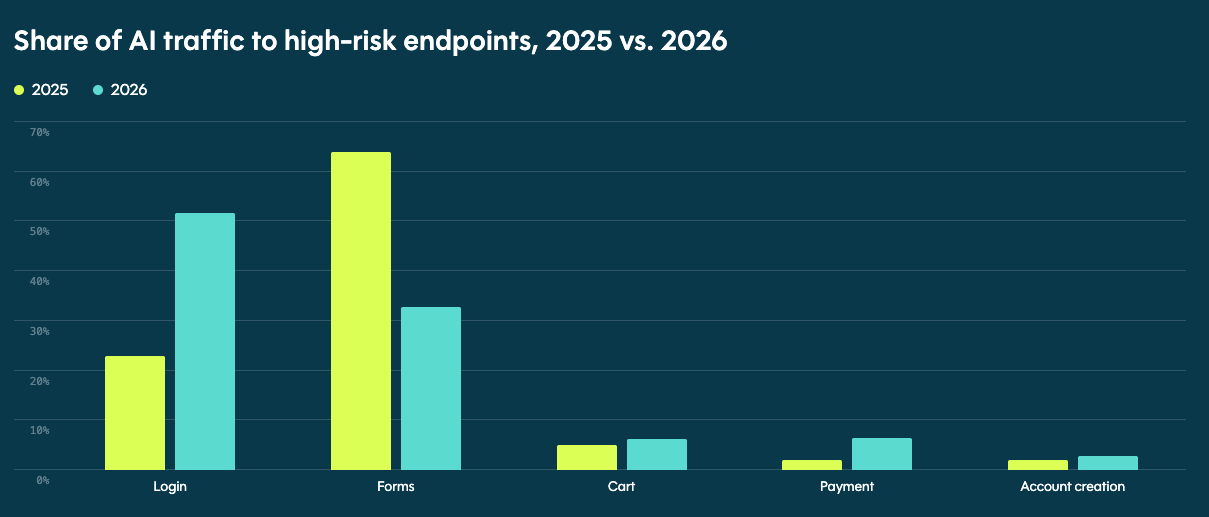
Login pages accounted for the largest share of this higher-risk endpoint traffic.
| Endpoint Category | Share of Higher-Risk AI Requests |
|---|---|
| Login pages | 51.7% |
| Forms | 32.8% |
| Payment flows | 6.4% |
| Shopping carts | 6.3% |
| Account creation | 2.8% |
Source: DataDome, January–June 2026. Percentages describe requests within the higher-risk endpoint categories, not all AI traffic.
Login pages received approximately 313 million AI-related requests during this period.
Monthly requests to login endpoints increased from 11.9 million in January to 99.7 million in June 2026, a reported increase of 735.8%.
In DataDome’s 2025 comparison, login pages represented approximately 23% of higher-risk endpoint traffic. Their share increased to 51.7% in the 2026 analysis.
This indicates that a larger share of observed AI-related requests to higher-risk endpoints was directed toward login functionality.
Does Increased Login Traffic Mean More Cyberattacks?
Not necessarily.
A request reaching a login page does not establish that authentication succeeded, an account was compromised, or the request was malicious.
An authorized AI assistant may need access to account information to complete a task. An attacker could target the same endpoint to test credentials or investigate authentication behavior.
Developers need additional context to distinguish these activities.
Useful signals include authentication outcomes, request frequency, session behavior, source verification, and the specific action being attempted.
For agents accessing private information on behalf of users, the principles of AI identity and access management are especially relevant.
Agents should operate with identifiable ownership, appropriately scoped permissions, and auditable access to sensitive resources.
The endpoint percentages describe destinations rather than completed transactions. A request to a payment page should not be counted as a successful payment without independent evidence.
AI Agent Spoofing Increased 45%
Many web crawlers identify themselves using the HTTP User-Agent header.
This information can help classify requests, but the header is supplied by the requesting client. An automated script can claim to be Googlebot, GPTBot, or another recognized crawler without actually belonging to that provider.
This behavior is known as user-agent spoofing.
DataDome reported a 45% increase in AI agent spoofing across its tracked agents between February and July 2026.
Reported rates varied by agent category:
| Agent Category | February 2026 | July 2026 |
|---|---|---|
| User-prompted agents | 1.4% | 5.6% |
| Search and answer bots | 1.9% | 4.7% |
| Crawlers and indexers | 3.2% | 5.7% |
These category-level figures represent combined rates for the agents included in each group. They should not be interpreted as a single traffic-weighted percentage across all AI requests.
The overall 45% increase is reported separately by DataDome. It cannot be calculated directly from one row of the table.
The spoofing measurement also covers a different period from the main July 2025–June 2026 traffic analysis.
The practical implication is straightforward: a recognizable crawler name is not reliable proof of identity.
How to Verify Whether an AI Crawler Is Genuine
Before assigning special treatment to an automated client, verify that it originates from the provider it claims to represent.
A practical verification process includes four steps:
- Identify the claimed crawler: Examine the user-agent token and determine which company or service it claims to represent.
- Verify its source: Compare the source IP with published crawler IP ranges where available. For providers supporting DNS verification, follow their documented reverse and forward DNS checks.
- Inspect request behavior: Review requested URLs, HTTP methods, request frequency, and response patterns.
- Apply independent access controls: Verified crawler identity does not authorize access to private accounts, user data, or transactions.
Google’s crawler verification documentation explains how to validate its crawlers using published IP ranges or reverse DNS followed by forward DNS confirmation.
OpenAI also publishes IP ranges for GPTBot, OAI-SearchBot, and ChatGPT-User in its official crawler documentation.
Managed bot protection systems can combine identity checks with network characteristics, browser signals, and request behavior.
However, even a correctly identified crawler must follow the access restrictions enforced by the application.
How Developers Should Protect Different Website Endpoints
Public articles, login pages, checkout flows, and APIs do not carry identical security risks.
Applying one aggressive bot-blocking rule to an entire website can interfere with legitimate search crawlers and authorized automation.
A better approach is to classify endpoints by sensitivity and apply suitable controls.
| Endpoint | Main Concern | Recommended Controls |
|---|---|---|
| Public articles and documentation | Excessive crawling and scraping | Crawler verification, request-rate monitoring, and deliberate crawler policies |
| Login and authentication | Credential testing and account takeover attempts | Authentication safeguards, rate limits, suspicious-login monitoring, and appropriate challenges |
| Private account pages | Unauthorized access to customer information | Valid sessions and resource-level authorization |
| Forms and registrations | Spam and fake submissions | Input validation, abuse detection, and submission limits |
| Checkout and payment | Fraud and transaction abuse | Session validation, fraud controls, and transaction monitoring |
| APIs | Unauthorized operations and excessive usage | Appropriate authentication, scoped permissions, quotas, and abuse monitoring |
For public content, crawler policies and reasonable rate limits may help manage automated access.
For private or transactional functionality, authentication and authorization remain essential.
A verified AI agent should never receive permission to access a customer’s data simply because its identity is recognized.
Bot protection services such as DataDome’s bot protection platform can assist with identifying and filtering automated activity across websites and APIs.
But bot detection does not replace secure application design, access control, and transaction validation.
What Developers Should Check in Server Logs
When AI-related request volume rises, server and CDN logs provide important information about where traffic originates and how it interacts with the application.
Instead of analyzing overall traffic alone, separate requests by endpoint and behavior.
Useful data includes:
- Timestamp: When requests occur and whether they follow unusual patterns.
- Request path and HTTP method: Which resources and operations are being targeted.
- Source IP and verified identity: Whether a request can be attributed to a known crawler or another client.
- User-agent: The identity claimed by the requester.
- HTTP status: Whether requests succeed, redirect, or produce errors.
- Authentication outcome: Whether sensitive requests pass or fail required security checks.
- Rate-limit and WAF events: Whether traffic is allowed, challenged, or blocked.
- Request correlation: Whether related requests reveal automated sequences or unusual activity.
When a website uses a CDN or reverse proxy, ensure that its client-IP configuration trusts forwarding information only from known infrastructure.
Do not blindly trust arbitrary forwarding headers supplied by external clients.
Logs should also avoid capturing passwords, authentication tokens, payment information, or unnecessary personal data.
Example: Investigating a Sudden Login Traffic Spike
Imagine a website that suddenly receives several times its normal request volume at /login.
That increase could come from legitimate customers, authorized AI assistants, automated tests, or malicious scripts.
A developer investigating the issue should:
- Compare current request rates with the site’s historical baseline.
- Separate verified crawlers and known integrations from unknown traffic.
- Review authentication failures, rate-limit events, and unusual request sequences.
- Check whether many accounts are being targeted or the same endpoints are repeatedly accessed.
- Investigate recent deployments or scheduled automation that could explain the spike.
- Apply targeted restrictions if suspicious activity is confirmed, then check for unintended effects on legitimate users.
This is an illustrative example, not a reported DataDome incident.
The objective is to interpret the behavior rather than automatically classify every automated request to a login page as an attack.
What AI Bot Traffic Trends Mean for SEO and AI Search Visibility
AI bot management is not solely a cybersecurity issue. It also affects content discovery, search accessibility, and how website owners evaluate AI-driven traffic.
Different AI crawlers perform different functions, and blocking all of them indiscriminately can work against a publisher’s search visibility goals.
For example, OpenAI documents OAI-SearchBot as a crawler used for ChatGPT search discovery, while GPTBot performs a separate model-related crawling function.
Website owners can manage these crawlers independently according to their content-access preferences.
Check Whether AI Crawlers Can Access Important Content
Allowing a crawler to request a page does not necessarily mean it can access all the information users see in their browsers.
Some AI crawlers have limited JavaScript rendering capabilities. If a website relies heavily on client-side JavaScript to generate its main content, certain crawlers may receive an incomplete version of the page.
Website owners should check whether important text, headings, links, and metadata are available in the initial HTML or through a rendering approach the intended crawler supports.
The guide to JavaScript SEO and AI crawlers explains how rendering, blocked resources, and crawl accessibility can affect content discovery.
Do Not Confuse Robots.txt With Website Security
A robots.txt file communicates crawling preferences to compliant automated clients.
It is not an authentication system or a reliable security boundary. Malicious automation can ignore its directives.
For private information, use actual authentication and access controls rather than relying on crawler exclusions.
Before changing crawler directives, a robots.txt tester can help validate rules and check how selected user agents would interpret access permissions.
There is also an important distinction between automatic crawlers and user-triggered agents.
OpenAI states that ChatGPT-User performs certain user-initiated retrievals, so robots.txt directives may not apply in the same way as they do to automatic crawlers such as OAI-SearchBot.
Website owners should therefore distinguish crawling preferences from technical access restrictions. Sensitive endpoints still require proper authorization regardless of which client makes the request.
Measure AI Visibility, Referrals, and Conversions Separately
For SEO and content teams, an effective monitoring strategy should separate four questions:
- Crawler accessibility: Can verified AI and search crawlers retrieve the public content you want them to access?
- AI search visibility: Is the website appearing in relevant AI-generated search experiences?
- AI referral traffic: How many identifiable visitors arrive from AI platforms?
- Business outcomes: Do those visitors engage with the website or complete meaningful conversions?
These measurements describe different stages of content discovery and user behavior.
An increase in GPTBot requests does not establish that a page is being cited in ChatGPT answers. Similarly, higher AI referral traffic does not prove that the website’s crawler activity increased at the same rate.
The most useful approach is to monitor each signal independently and evaluate its impact on website performance.
What the 2026 AI Bot Traffic Trends Mean for Websites
DataDome’s 2026 research shows that AI-generated traffic is increasing and that automated clients are reaching more parts of websites, including account-related and transactional endpoints.
These findings should not be interpreted as proof that all AI agents are malicious. They highlight the need to distinguish legitimate automation from suspicious activity and understand the context surrounding each request.
For developers, that means improving traffic monitoring, verifying crawler identities, reviewing sensitive endpoints, and enforcing appropriate authentication and authorization controls.
For SEO teams, it means maintaining access for legitimate discovery systems while measuring crawler requests, AI search visibility, referrals, and conversions separately.
As AI assistants become more capable of navigating websites and completing tasks, treating every automated request identically will become increasingly difficult to justify.
The stronger approach is to understand who is requesting access, what they are trying to accomplish, and whether the application should permit that activity.
About Himanshu Tyagi
At CodeItBro, I help professionals, marketers, and aspiring technologists bridge the gap between curiosity and confidence in coding and automation. With a dedication to clarity and impact, my work focuses on turning beginner hesitation into actionable results. From clear tutorials on Python and AI tools to practical insights for working with modern stacks, I publish genuine learning experiences that empower you to deploy real solutions—without getting lost in jargon. Join me as we build a smarter tech-muscle together.



Comments
Comments are provided by Disqus. Loading them connects to Disqus, which sets cookies and processes data under its own privacy policy.